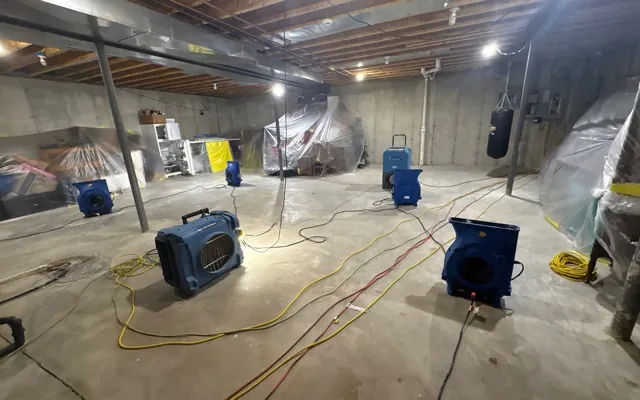
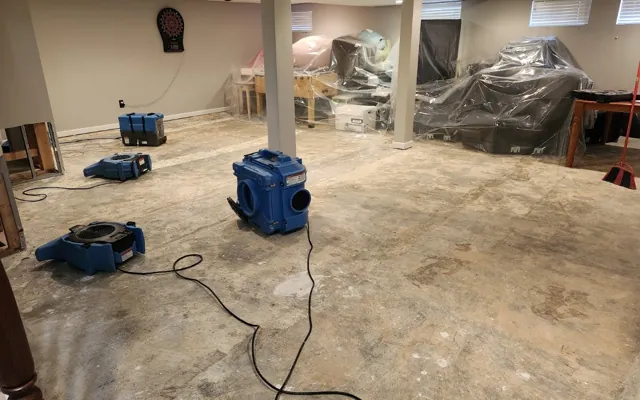
When a basement floods in Pittsburgh, GA, local crews respond fast. They follow IICRC-standard methods to extract water, remove damage, and dry the space to a verified target, preventing hidden mold and structural rot in these older homes.

Technicians start by pumping out deep standing water with submersible pumps. Then, truck-mounted extractors pull moisture from carpets, padding, and hard surfaces across the finished basement, preparing the space for the drying phase.
Soaked insulation, carpet pad, and drywall that wicked water above the flood line are cut out. This step in Pittsburgh homes ensures no trapped moisture remains sealed inside walls, preventing future mold growth.
Air movers and industrial dehumidifiers run to reach IICRC-standard dryness targets. The team maps moisture daily until framing and subfloors read dry, verifying the basement is thoroughly dried, not just on the surface.

Basement flood cleanup in Pittsburgh typically runs from about $2,500 to $9,000, depending on the depth of water, how much finished material has to be removed, and whether the water is clean or contaminated. A shallow clean-water event sits on the low end, while a deep flood with Category 3 water across multiple finished rooms reaches the high end. Sudden losses are commonly covered, and the crew documents each item for the carrier.
In the historic Pittsburgh neighborhood of Atlanta, closely spaced homes from the early 1900s have aging plumbing and roof systems. A slow leak in these compact, older basements can quickly become a major flood, threatening the framing and finished materials common in lower levels. Aging plumbing and roofs in Pittsburgh's century-old homes invite slow leaks. Combined with the area's humid subtropical climate and red-clay soil, this can lead to persistent dampness and sudden backups, making swift basement flood cleanup critical. From Pittsburgh, crews also cover nearby Peoplestown, Cabbagetown, Grant Park, Inman Park, West End, Old Fourth Ward. See every neighborhood and town on the full service area page.
See all areas servedEvery loss is photographed, measured, and logged from the first visit, so the paperwork holds up with your insurance carrier.
Technicians follow recognized IICRC drying standards and prove the work with daily moisture readings, not guesswork.
Emergency dispatch any hour of the day or night, with a real crew on the way, not a callback in the morning.
A real crew dispatched any hour, not a callback in the morning.
Trained technicians following recognized IICRC drying standards.
Truck-mounted, portable, and submersible for any size loss.
The loss is documented and billed to the carrier directly.
Costs in Atlanta typically range from about 2,500 to 9,000 dollars. The final price depends on water depth, the amount of finished material removed, and if the water is clean or contaminated. Local crews document everything to support the insurance claim.
Drying a compact Pittsburgh basement usually takes several days. Technicians use air movers and dehumidifiers to reach IICRC dryness targets, mapping moisture daily. They verify that the framing and subfloor are dry, not just the surface, before completing the job.
Crews are on call 24 hours a day and can be on the way to Pittsburgh within the hour.
Call (678) 990-6039