When a supply line fails in Pittsburgh, GA, the local crew responds fast to contain the water and prevent structural rot. They follow IICRC-standard methods to dry the home's compact framing to a verified target.

Technicians first secure the main water valve to stop the flow. They then map every room and cavity the pressurized water reached in the Pittsburgh home, setting up containment to protect unaffected areas.
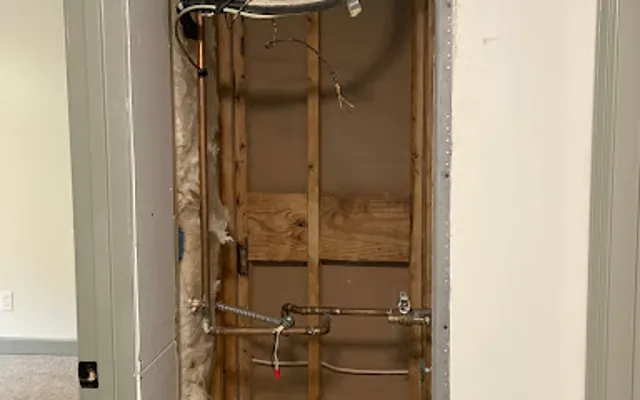
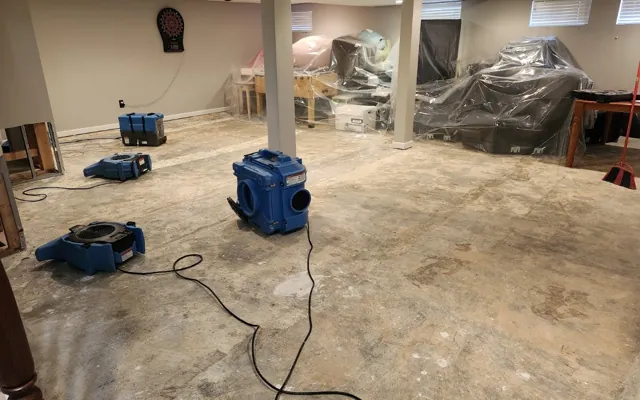
The team extracts all standing water. Wet drywall, baseboard, and insulation are carefully opened to expose the wall cavities and floor framing, ensuring the structure itself can be dried completely.
Industrial air movers and dehumidifiers dry the framing and cavities. Technicians take daily moisture readings until the entire structure meets the dry standard, verifying the home is saved.

Supply line failure cleanup in Pittsburgh commonly runs from about $1,500 to $7,000, driven by how long the line ran before shutoff, how many rooms and cavities the water reached, and whether multiple floors are involved. A quick catch in one room sits at the low end, while a line that let go while the home was empty reaches the high end. The crew documents readings and photos so the carrier has clear support.
In Pittsburgh, GA, a neighborhood of closely spaced, early-1900s homes near the old rail yards, aging plumbing is common. A failed supply line in one of these small houses can send water racing through multiple rooms and into wall cavities, threatening the wood framing and foundation with rot if not handled properly. In Pittsburgh, the core issue is the aging plumbing systems in the neighborhood's many century-old homes. These original pipes, combined with the area's clay soil shifts, are more vulnerable to sudden failure, sending pressurized water into compact spaces. From Pittsburgh, crews also cover nearby Peoplestown, Cabbagetown, Grant Park, Inman Park, West End, Old Fourth Ward. See every neighborhood and town on the full service area page.
See all areas servedEvery loss is photographed, measured, and logged from the first visit, so the paperwork holds up with your insurance carrier.
Technicians follow recognized IICRC drying standards and prove the work with daily moisture readings, not guesswork.
Emergency dispatch any hour of the day or night, with a real crew on the way, not a callback in the morning.
A real crew dispatched any hour, not a callback in the morning.
Trained technicians following recognized IICRC drying standards.
Truck-mounted, portable, and submersible for any size loss.
The loss is documented and billed to the carrier directly.
Costs in Atlanta typically range from about 1,500 to 7,000 dollars. In Pittsburgh, the final figure depends on how long the line ran, how many rooms and wall cavities were affected, and whether water traveled to multiple floors in these older homes.
In these older homes with compact framing, water from a pressurized line gets trapped inside wall cavities. Opening the wet sections is the only way to dry the wood structure to the standard and stop hidden rot or mold.
Crews are on call 24 hours a day and can be on the way to Pittsburgh within the hour.
Call (678) 990-6039